Paper Things I Use
By Artyom BologovRecently, I decided to solve the problem of attention economy and tech enshittification. Radically. By moving away from digital tech to analog tech. Including: paper (hyper)media!
I’ve gone as far as starting a No Laptop Week to try and see how long I can live without my laptop. Spoiler: not long, as I’m writing this post on the laptop. But the goal of the challenge is already fulfilled: I moved most of my workflows away from tech and into my numerous (splitter!) notebooks.
This page details what kind of paper things I use to organize my (woefully disorganized) life. And all the useful resources I found along the way.
In case you prefer to read things on paper, you can print a PDF version of this post and read it in your comfy chair with your marginalia-specific pen.
This is a large post, here’s a Table of Contents
Workplace: Soviet Dining Table #
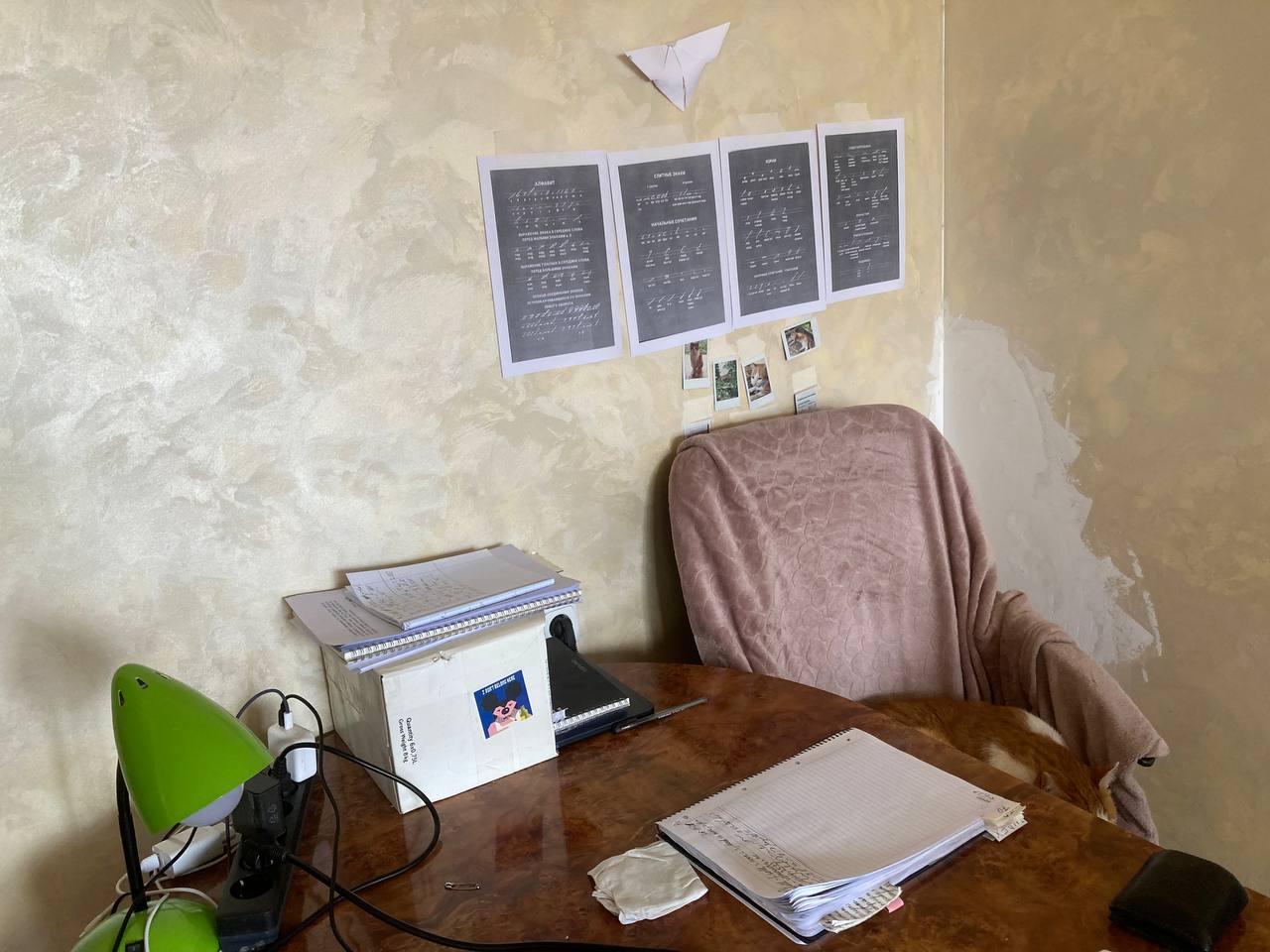
When I was checking flats for rent, I found this nice flat in a quiet neighborhood. Which was a huge factor, because I can let my cat stroll freely around there! And yet another factor was… a dining table in the living room. It was really sturdy and large, perfect for a workplace. I abandoned my (modern yet inconvenient) desk and moved everything to the dining table. Now it’s quite chaotic, but I like it anyway!
This is literally a foundation of all my paper workflows, in all their variety.
Stenography / Shorthand #
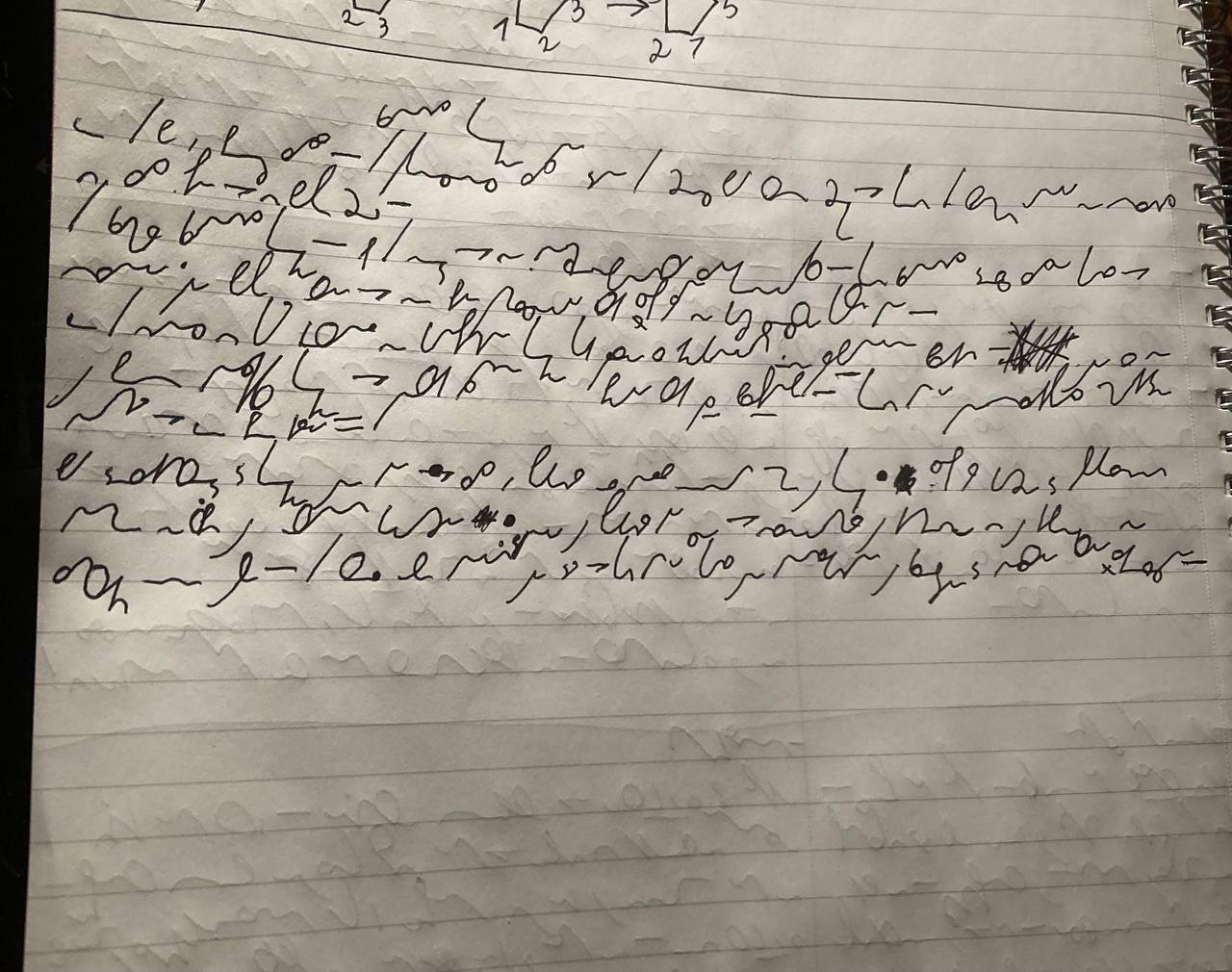
Around 1949, in Ithaca, upstate New York, the throbbing which had never quite ceased, began to plague me again. Combination joined inspiration with fresh zest and involved me in a new treatment of the theme, this time in English […] Lolita was energetically resumed in the evenings or on cloudy days. I finished copying the thing out in longhand in the spring or 1954, and at once began casting around for a publisher.
So stenography / shorthand is this way to write real fast. Contrasted with regular cursive / longhand, which is quite suboptimal. If I ever to replace digital tech with analog tech fully, I need to rival the typing speed with handwriting speed. There’s only way to do that: optimizing the writing. Meaning: shorthand, or as it’s called in Russia, stenography.
Being bilingual (and hoping to become trilingual or more!) I needed a system that’d work for both Russian and English. I searched for Armenian shorthand, but found no satisfying system. So I reached for Soviet stenography system called GESS. Because Russian phonetic repertoire is almost a superset of English (while Armenian is a superset of both!)
I could’ve come up with a new system. But I’m too dumb to make a good one, even having all of the Internet at my disposal.
So I’m currently at the stage of GESS proficiency where I can confidently write at a speed around 30 words per minute. It’s not much, but is already faster than writing in longhand. And, given that I’m really a slow thinker, I don’t lose much thoughts even with such a meek speed!
Not all genres and purposes require stenography, though. These uses that require fast recording and can stand slow reading are fine. So diaries, accounting books, and writing notebooks work with stenography. But something like a Commonplace book that needs quick lookup and reading is totally not fine with stenography. Speaking of which, the principal tool in my paper-oriented life:
Knowledge Repository: Commonplace and Index #
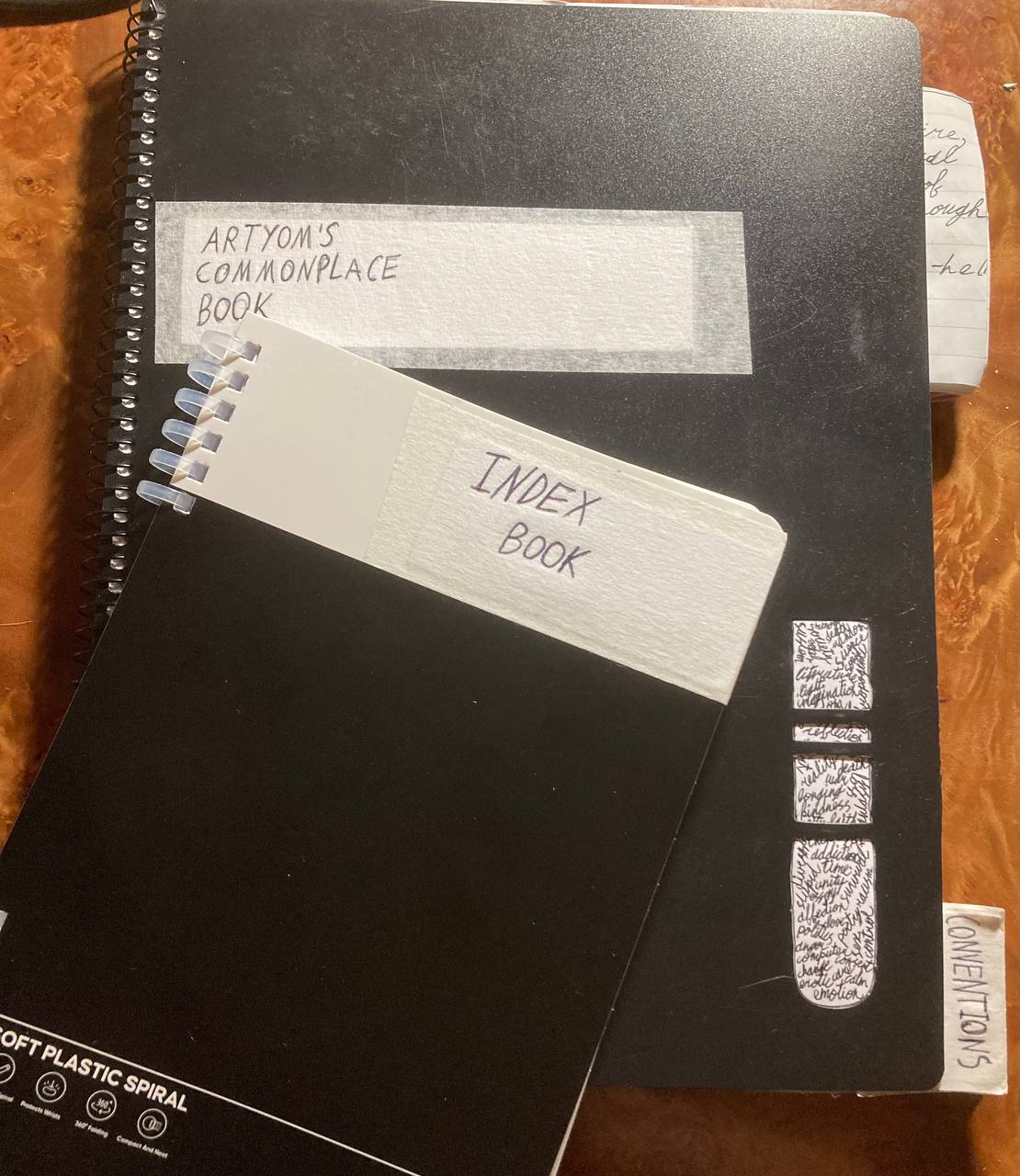
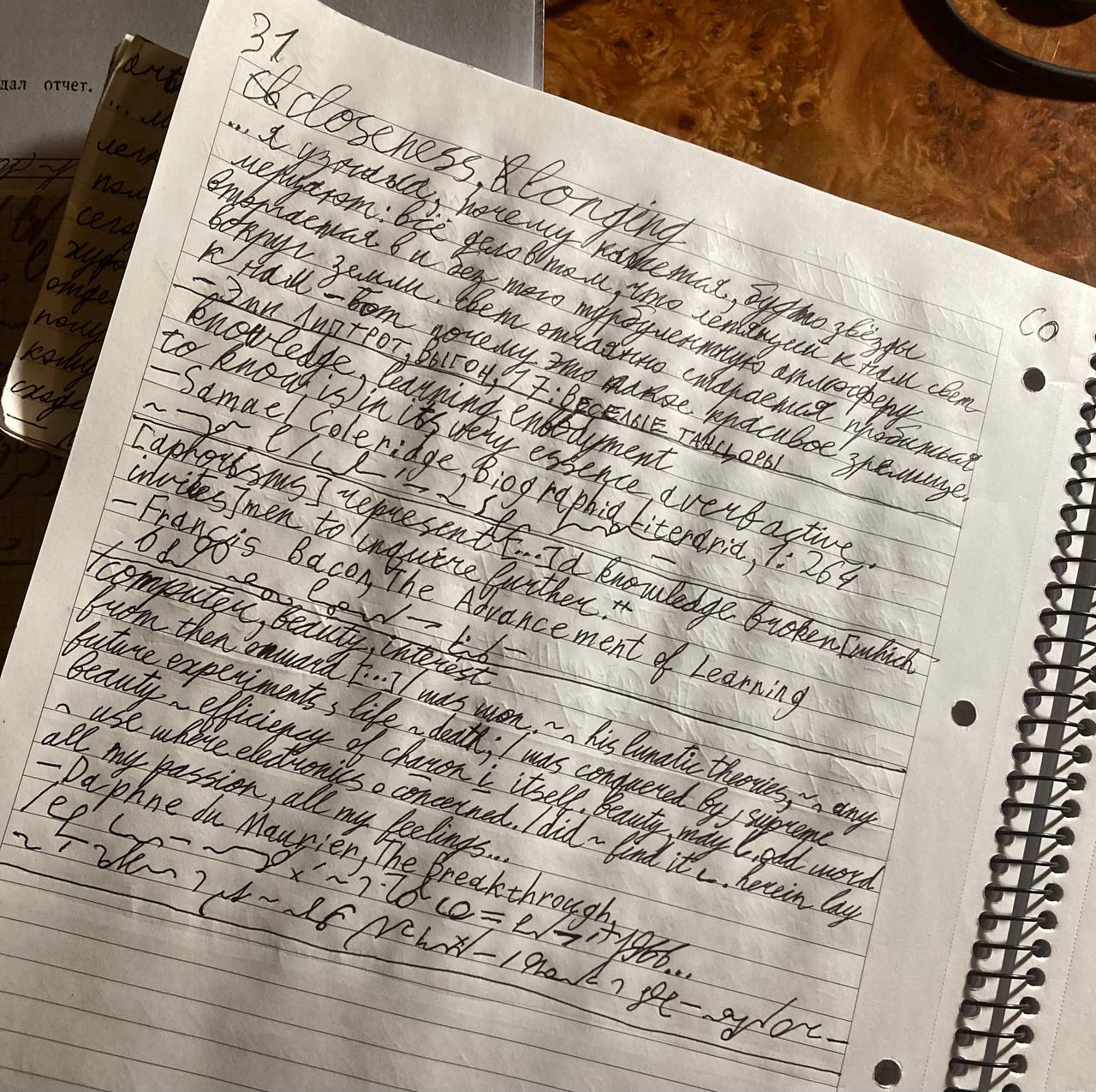
This sturdy plastic-bound notebook always sits in the center of my table. Being the main repository of quotes and reflections on things I read. It’s split by initial+first-vowel pairs and has links to previous / next pages on the margins. Every entry has
- Tags / concepts
- Date (to position pieces of reflections in time)
- Quote or factoid
- Attribution, as exact as possible (I sometimes even number the unnumbered chapters in some books!)
- And some reflection written stenographically
I have a separate notebook for indexing of the main Commonplace.
Because indexes need a lot of space to be useful and searchable!
Especially with the systems I use.
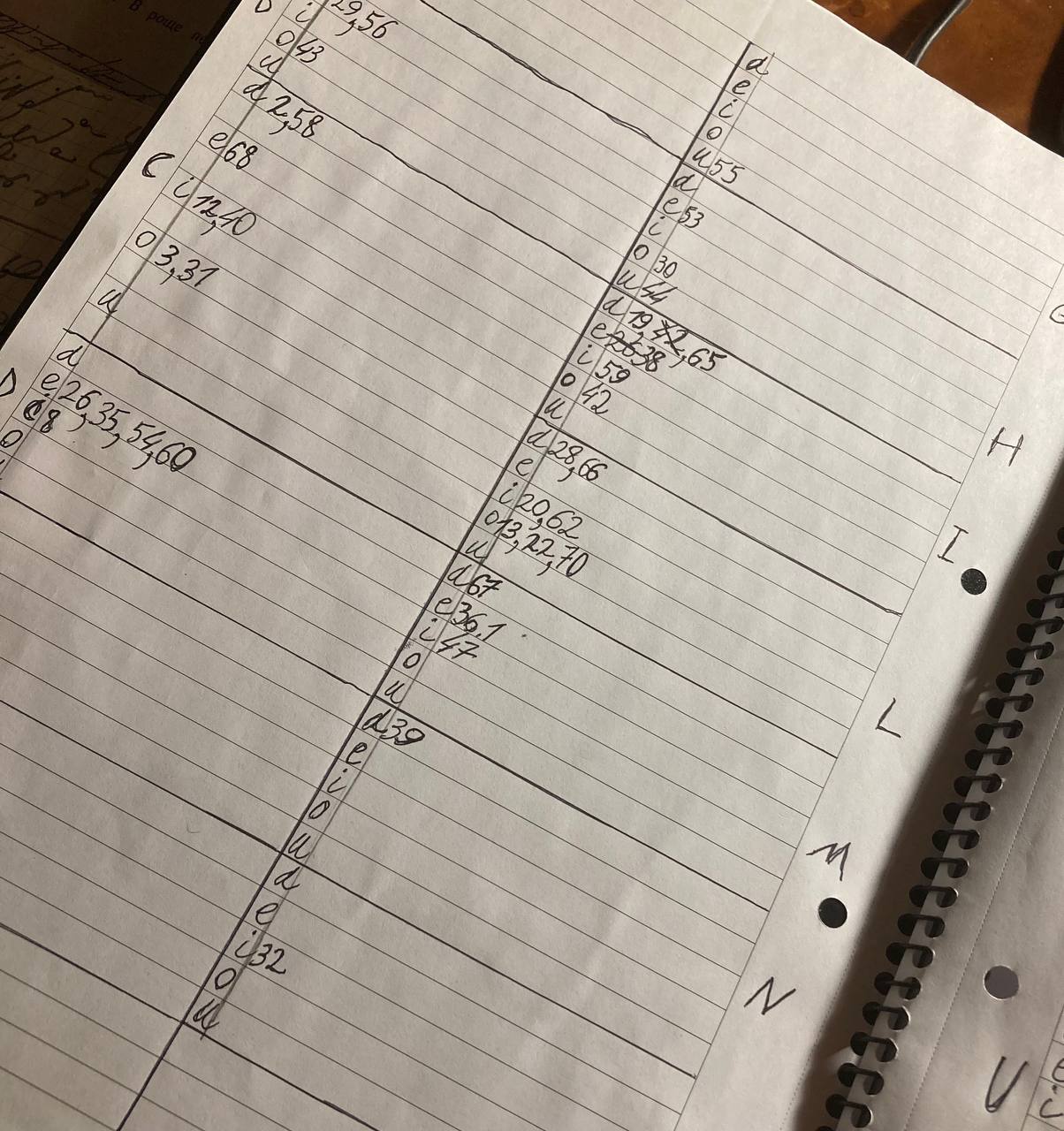
So there’s a bunch of indexing systems one can use for a notebook or a Commonplace. Some more elaborate, some less. But what I settled on is a mixed Locke / Walker system. Here’s a full description:
- My first and main indexing / Commonplace technique is John Locke’s Commonplacing Method. It is criticized a lot by subsequent authors, but I find it useful to find things at a glance and to structure pages by letters. The essence is: allocate a couple of pages for an alphabetic index, with subdivision by the first vowel of the word. And structure the rest of the notebook with every page having only one initial+vowel entries on it. This way, concepts can be looked up by their obvious first letters and can be found promptly.
- The second structure that I’m currently using for the Index Book is John Walker’s system. The whole Index Book is split into scores of letter-oriented pages, where certain spelled-out concepts are mapped to page / entry numbers in the actual Commonplace. It’s even more concept-oriented, which I like! And it allows for richer indices, so that multiple-concept entries (the majority of what I do, because I essentially tag every entry with as much concepts as I can) can be added to the index at will.
- I modify their system with intra-page references (to previous / next pages of the same letter combination and to pages with similar concepts on margins.)
- I also add tabs to the bottom of the book so that I can quickly leaf through it to the necessary page without straining the paper too much.
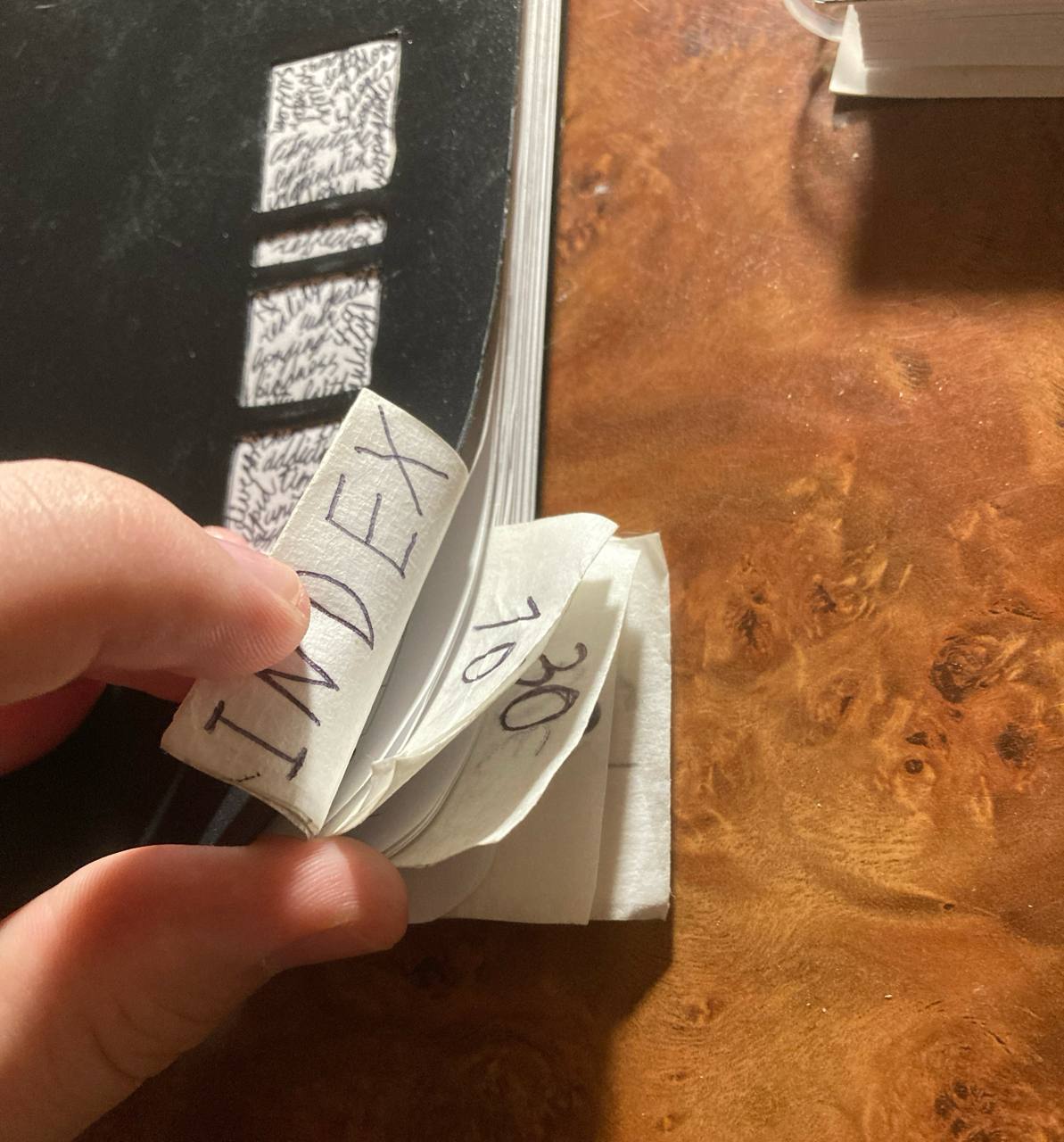
Most sources on the Internet recommend single-letter indices, which lose important info and are less structured. Indexing by initial+vowel pairs like Locke and Walker is more evocative. They knew their shit, living in paper-only world!
Reference Materials Wall #
As seen in the photo above, I have a wall plastered with reference materials and polaroids of my cat. These—especially cat polaroids—are important! Because I do need some quick reference info on my wall at all times. I’ll likely add more references, like ASCII table or Scheme standard library. Time will tell.
Notebooks #
I have many notebooks really.
First, there is a bunch of notebooks I use to manage my life:
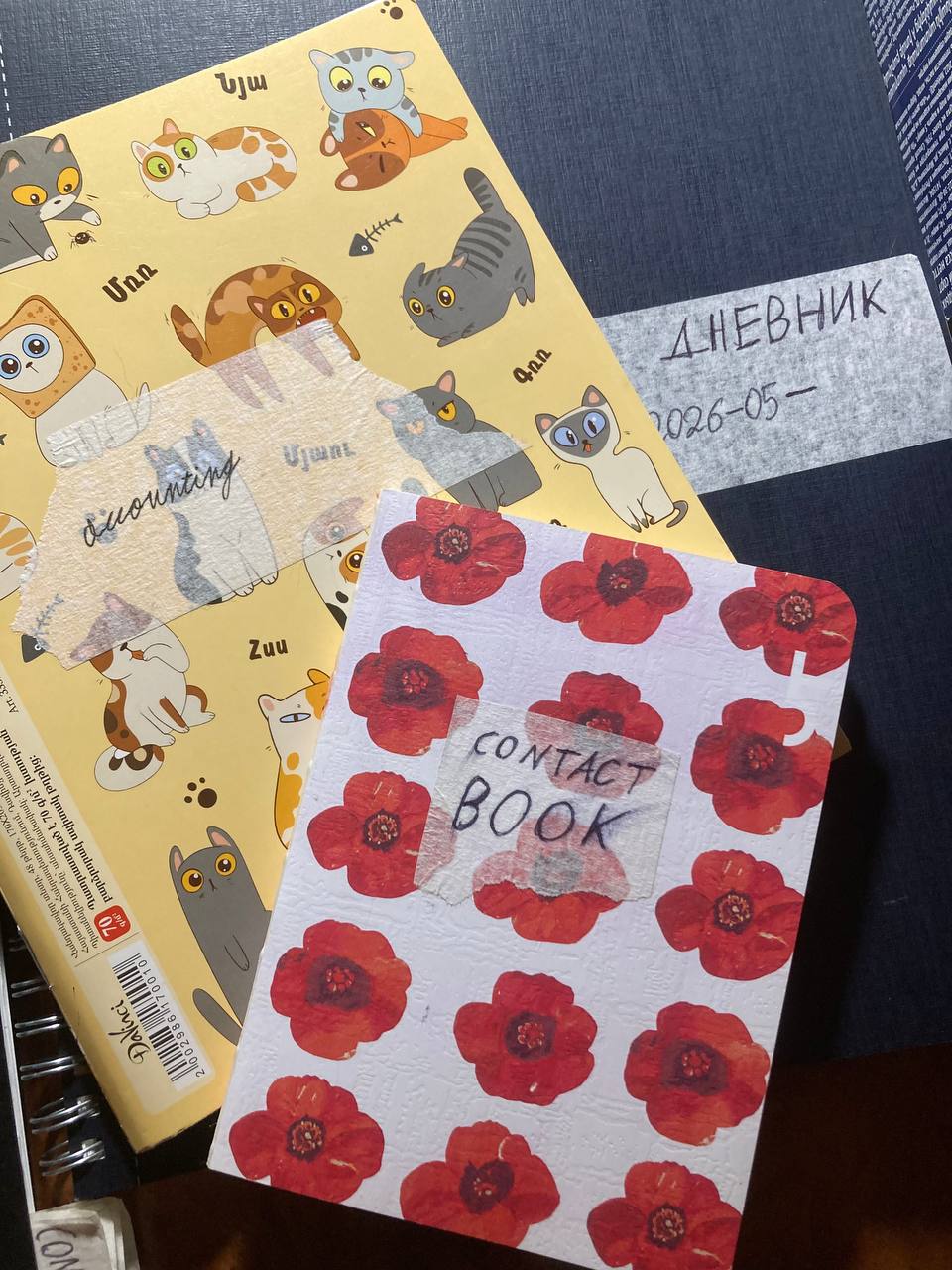
I keep the diary in GESS, accounting in GESS and Kaktovik numerals, while the contact book is structured after the aggregate statistics derived from my 300-entry phone contact book and some BBDB emails. I lost the code I used for these stats, otherwise I’d show it to you. But the gist of it is that “A” takes almost 30 pages, “E”—almost 10, “K” and “M”—5 each, “S” and “V”—10 each, “Y”—5, and the rest is mostly 1–2 pages. That seems to be the structure for Russian names—lots of A-s.
I don’t use ready-made contact books, because their letter distribution sucks.
And because there’s not much choice of these in Armenia.
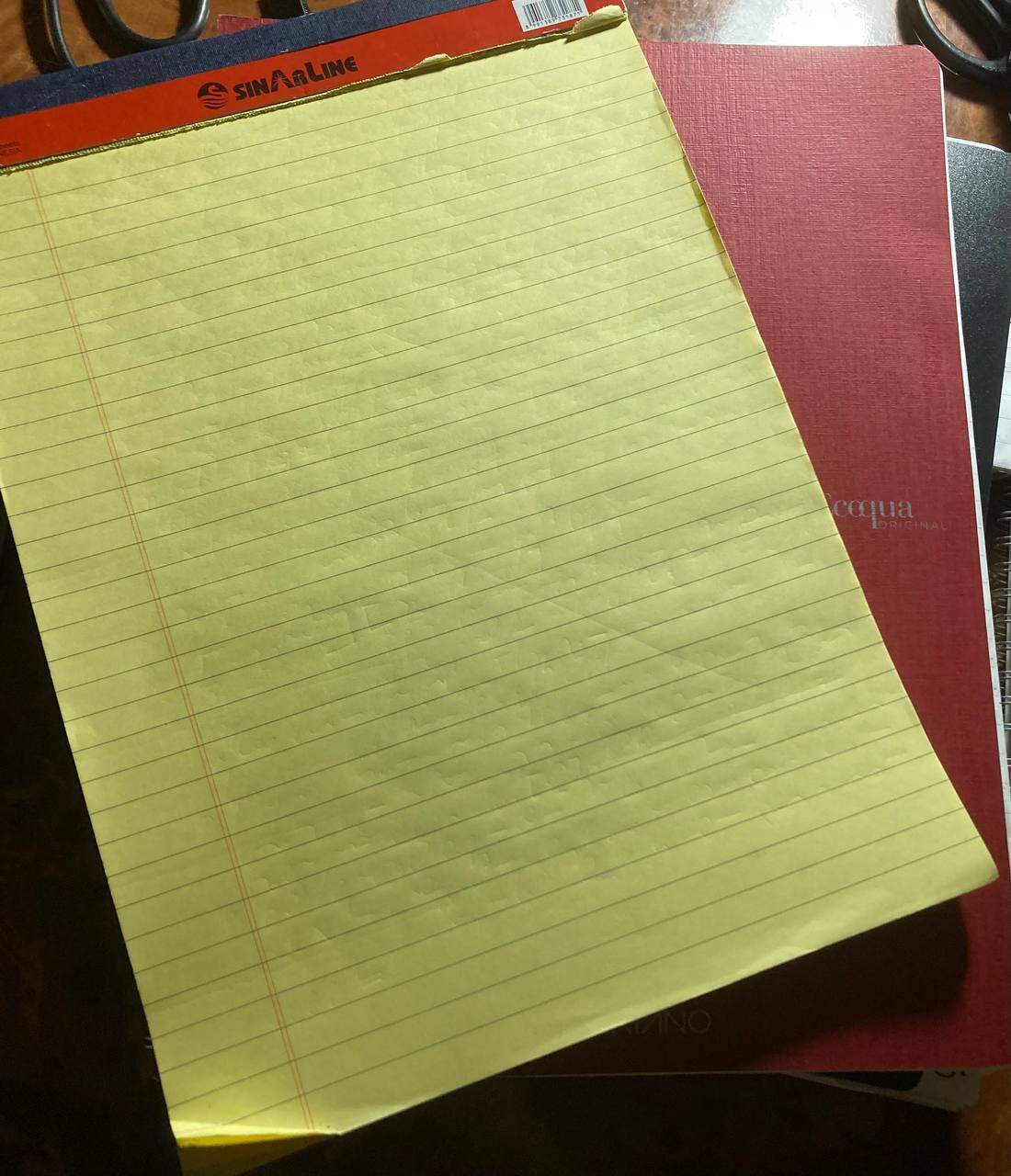
Then I have my “work” notebooks. Which is an euphemism for a chaotic hodgepodge of writing, doodling, calculations, and whatnot. But I try to keep writing there. So I have a fancy red spiral-bound one that I write in at home, and where most of my drafts live. And I have a tear-off notebook that I use to capture ideas or draft things when not at home. Then I tear pages out of it, and either transcribe these to the laptop, or put them away until I get to the fancy notebook and continue the work.
Of course, both work notebooks use GESS stenography and Kaktovik numerals.
Editing on paper #
Writing and editing on paper is significantly different from digital editing. With digital, you can easily erase and replace basically anything. It’s extremely malleable.
With paper—there’s no such luxury. I had to get inventive to make my writing editable. Approaches that I tried and that didn’t work:
- Semantic linebreaks, one sentence per line. Stenographic sentences tend to be very short, so this was a waste of space. I basically had a whole page taken vertically and occupied at best 40% horizontally.
- Double-spacing and line skipping. Even more wasteful and useless. I tend to edit much less than I draft. Edits take up at most 10% of the text if these are full sentence edits.
- Proofreading marks. Entirely useless. They take a lot of space and only work with double-ish-spaced text. And printed text, mostly. If you write by hand and edit by hand, you can just cross out or insert quotes directly.
The most productive editing technique was… footnotes.
So I basically write text in full, somewhat in automatic writing fashion. And then edit.
Then I cross out the sentences I don’t like. Cross out words and insert new ones with vertical arrowheads (from proofreading marks.) And when I need to replace a part of a sentence, I just write the new sentence at the end. On its own line. Mark it as a footnote. And write the footnote number over a crossed-out sentence. That’s more than enough for most texts.
TODOs and planning #
What’s missing in this list is some way to manage TODOs. I don’t have any. Because
- I’m bipolar and things go sideways more often than not
- I have N24, so time is mostly irrelevant to me
- I’m on my sabbatical so I don’t have any hard deadlines or goals to accomplish
- I have a single-threaded mind, so anything I do—I do until it’s done or until I’m bored; no TODOs necessary
- I get bored too often, so I switch between notebooks, Commonplace, and books
I bought a highschool planner to plan things in, but I abandoned it soon afterwards—I simply had nothing to plan in it.
Printed Books #
So I’m a huge reader, since early life really. I abandoned reading when I joined my last job. But I quit since and started to read again—to much joy.
I prefer printed books. Yeah I know—not environmentally responsible. But printed word reads better. Strains eyes much less. And has affordances like dog-earing and page doodling—built in.
So I tend to buy Collins and Penguin books because other publishing houses are expensive on Armenian market. These are not the most indexable books—unlike publishers like Ad Marginem. But it’s unstructured fiction anyway, so who cares? Yeah, I mostly read fiction, because I think in stories and not in facts.
My reading is usually split over different genres / purposes to not overload my brain with just one of them:
- Small pocket books (Penguin Pocket Classics, usually) for reading on the bus or in queues (there are lots in Armenia!)
- Bigger fiction books at home, for calm reading with pencils and Commonplace.
- Serious things like math and stenography prints, right at my desk for immediate work and interaction.
My workflow with fiction books then is:
- Read a chapter or another unit of the book.
- Dog-ear pages with important info and highlight the salient passages.
- If there are unfamiliar words in the text, write them out on the back of the book or dog-ear and underline.
- Once the chapter is done, transfer the quotes to the Commonplace and reflect on them. I lose some insight this way, but it’s more optimal than interrupting the process with endless recording.
Tarot #
I do not believe in Tarot divination.
Yet, I love Tarot!
Because it’s a nice story generator and a source of randomness.
I write Tarot stories,
which is an euphemism for “generated by prompting the (undoubtedly intelligent) deck of cards and hallucinating the story.”
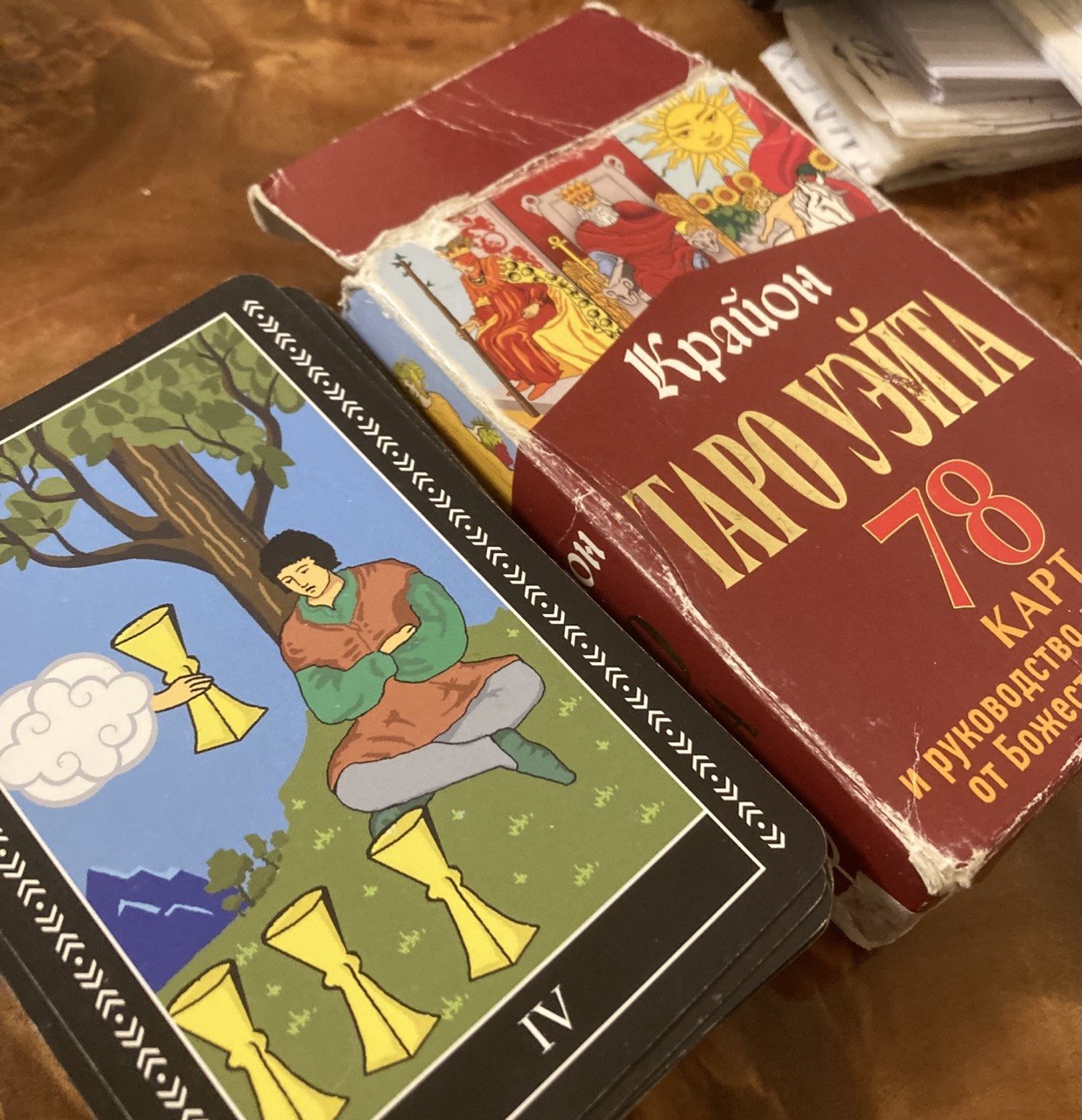
This deck found me (every Tarot person says that) in one of the Yerevan bookshops, being the last Tarot deck they had left. It’s bright, it’s undetailed, it’s promoting a Russian orthodox sect. And it’s incredibly crappy quality wise. Yet, I love it and write stories based on it!
I tend to just pull out a card. Read the interpretation (I have these printed out.) And fantasize about what story / character this might be about.
Sometimes I do spreads, making longer stories with episodes based on individual cards. But I really like shorter one-card stories, so expect more of that!
See Also #
That’s about it for my current analog setup! It might not be satisfactory if you expected a full external brain Zettelkasten thing. But I’m a chaotic story person and not an academic. Anyways, here are some more references to build your own analog brain:
- How Romantics and Victorians Organized Information: Commonplace Books, Scrapbooks, and Albums is a huge repository of knowledge on Commonplace books in pre-digital times. That’s where I found the reference to John Walker’s method and many others. I haven’t yet finished reading it, but I anticipate many useful findings yet!
- Analog Office is a treasure trove of references, with Office Toy: the A-Z Sorter and How to Set Up a Table of Contents or an Index being the richest in references. The systems Anna describes and links to are quite primitive. But what I inherited from these was the alphabetic distribution of words, which I use to add extra pages to my Index Book and Commonplace index spread. The heuristic is: twice the pages for C, and a couple of additional pages for S and T.
- Lion’s How to Record Every Thought is a really elaborate system for recording thoughts and references. I couldn’t ever dream of ever rivaling this system, but I don’t have to! Give it a read, well worth it.
- Ellane’s Plain Text. Paper, Less cycle is another huge repository of knowledge, including Johny.Decimal, dash-plus, and indexing entries, among many others. I haven’t got to reading all of it yet. But I will!
- Writing at Large, despite the name, is a blog on sketching, drawing, and art supplies. And less about writing and information structuring.
- How to manage your Moleskine is a Moleskine-focused resource with many references collected from Moleskine community. (I neither support nor endorse Moleskine due to animal cruelty they promote, but you do you.)
Go analog, reject computerized gentrification!