Armenian Shorthand (Սղագրություն) System from 1888!
By Artyom Bologov
So, as I posited before, I’m learning stenography, also known as shorthand writing. And I want to use the most universal system for stenography, because I don’t know what languages I’ll write tomorrow. Might be English, might be Russian, might be Interslavic, might be Armenian. Out of all these, Armenian is the richest in terms of alphabet and phonetics, being almost a superset of Russian and English. Well, except for “ы,” but we don’t talk about it here.
That’s why I was interested in Armenian stenography. Secretaries and journalists must’ve learned it in Soviet times or even before, right?
And yet, there seems to be no Armenian shorthand system I can get my hands on. Stephen Masters have graciously suggested I can try National Assembly of Armenia or look for stenography books by Mekhitarist congregation. They didn’t let me into National Assembly to find their stenographer and ask the life out of them. But Mekhitarist lead was hella on point!
I have annoyed National Library of Armenia employees more than once. First time I came, a really patient librarian sifted through tons of index cards. And found books on GESS stenography system I was already studying back then. And Hakobyan’s system (that I now regret not trying out.)
Second time I came, I got a really thick copy of a book with exercises on GESS. Mostly useless, because GESS is heavy with outdated Socialist shortcuts.
But third time I was armed with knowledge about Mekhitarist congregation and existence of stenography book by them.
I was filled with determination.
And an extremely knowledgeable and inventive librarian found the Armenian word for stenography (“սղագրություն,” sghagrutyun.)
I tried to translate the word myself, to no avail:
Anyway, now we have the word!
And there actually was a book with that word in the name.
My treasure I keep close to my digital heart: “Armenian Stenography based on the System by P. K. Kapelsperker” from 1888!
Those into stenography systems may recognize the surname: it’s garbled Gabelsberger in Western Armenian.
So yes, this book is yet another Grabelsberger progeny!
History of Shorthand #
Most stenography books try to sell stenography to you. In one way or another. GESS books tried to sell stenography as a productivity tool and labor optimization. Even though by the time these were written, there already existed typewriters (1937) or computers (1991.)
This book tries to sell stenography as a natural consequence of progress. Like, look, many languages moved from clumsy geometric (Hebrew) or iconic (Ancient Egyptian) forms to cursive. Stenographic writing is just a mere step ahead!
They mention
Tironian notes,
Christian writing, and their shortcomings.
These were mostly abbreviations and not proper scripts.
A nice diagram listing Armenian abbreviations follows:
Taylor and Pitman (transliterated as Bidman) are mentioned too. And, finally, they arrive at Gabelsberger. And their desire to enrich Armenian with a stenographic system Taylored (sorry) to the language. It’s a nice section, especially compared to other ones.
Universal Alphabet #
There’s a nice aspiration expressed in the introduction:
In short, shorthand now has many propagandists in Europe, whose goal is to completely generalize it among other nations and to hand over the function of the ordinary system to the shorthandist, and like the Arabic symbols in numerology, to establish a national system in shorthand, instead of a multinational alphabet for each nation.
Armenian Alphabet #
I’m not sure if this is the first publication dissecting Armenian alphabet. It likely isn’t. Still, a large part of book’s value lies in this analysis. And how it informs the stenography system.
So, in addition to typical vowels and consonants division. They also add diphthongs and an additional category of vowel clusters with ու. And some syllables. They also split consonants into groups:
- լերկք (sorry, no translation—neither Google nor Yandex Translate can handle these!)
- Kind of average-ish sounds. Not too hard, not too airy. As a Russian, I recognize that most of Russian consonants fall into this group.
- միջինք (middle)
- I have no idea why these are called “middle.” But these are all the hardest explosive sounds of Armenian.
- թաուք
- Light, airy, soft sounds. Mostly just breaths with some sounds.
- հագագայինք
- These are just three variations of “h.” Yeah, Armenian has three! I have no idea why they didn’t put it into the previous three groups, because the dynamics of these “h” variations roughly repeats the other consonants: “հ” (h) is airy, “խ” (kh) is medium, and “ղ” (gh) is hard. But whatever.
- նայք
- Roughly corresponds to nasal and trill/flap sounds. I’m guessing because these sounds can be prolonged by continuing the breath.
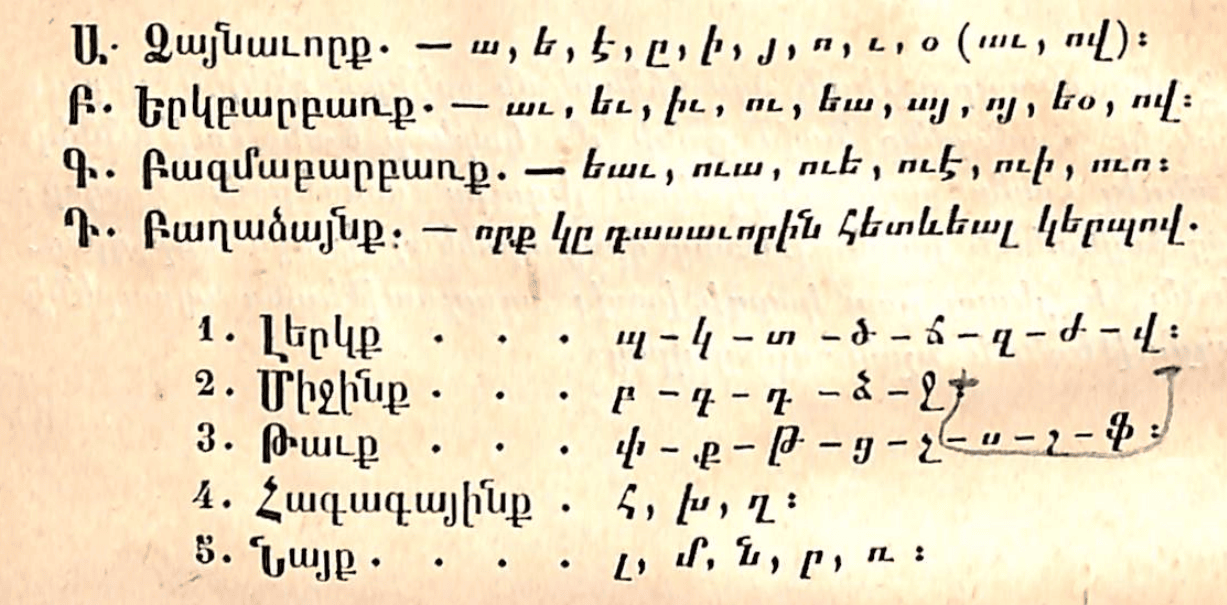
This classification is quite intuitive and puts similar sounds in the sample places in different groups. Like with “բ-պ-փ” (b-p-p') vertical or “ճ-ջ-չ” (tch-j-ch) vertical. This is also reflected in the actual stenography system.
Consonants: Suboptimal #
Armenian is a big language, with 39 letters and some ~50 sounds (some digraphs and diphthongs.)
And dialects and pronunciations.
They make the grouping for these in the book and arrive at 41 necessary glyphs.
With 29 consonants.
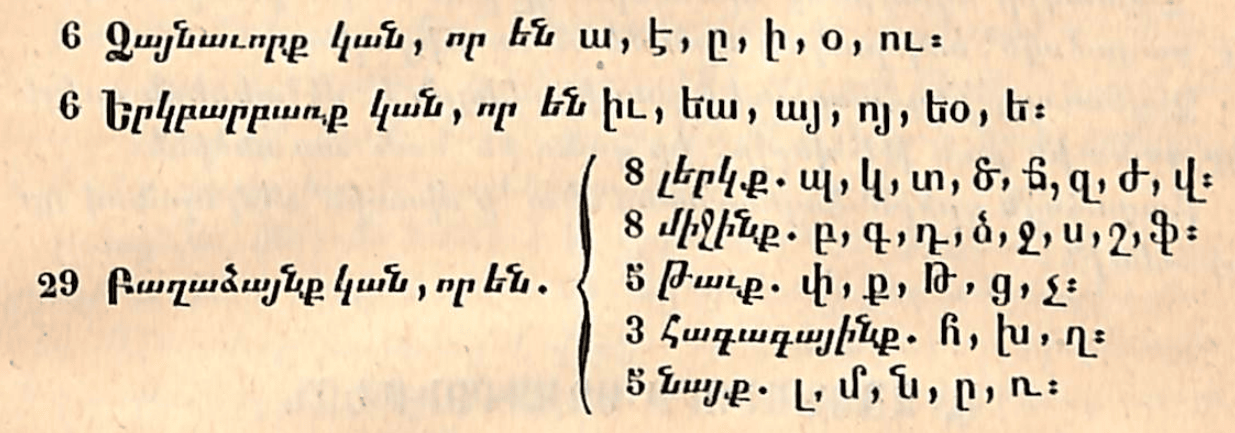
A stenography system devised for 26/30 German letters might not be enough.
And it’s not enough, which shows in the overly complex glyphs for consonants like “թ,” “չ,” and “ց.”
These are not feasible to write.
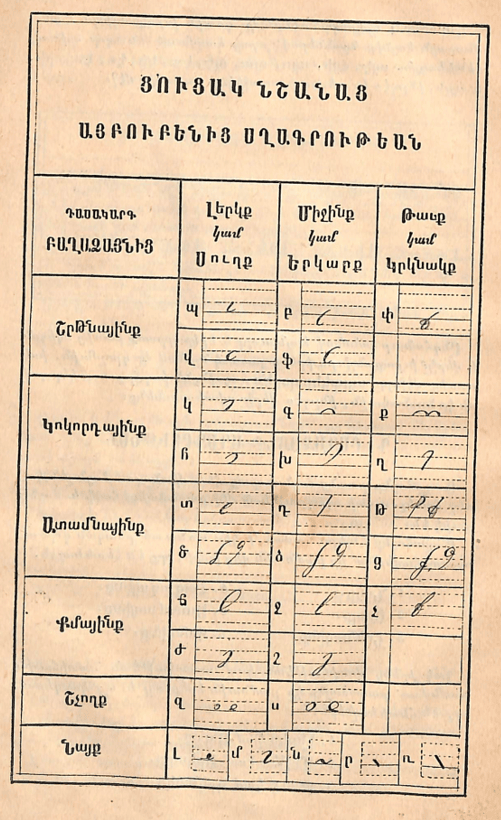
This letter frequency page reveals: “թ” is more represented than “դ,” among others. I guess they didn’t really have letter statistics in 1888. Neither they had Markov in Venice, it seems. Forgivable mistakes. Making the system suboptimal for writing.
Vowels: Hard to Fuck Up #
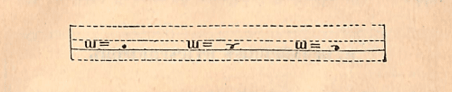
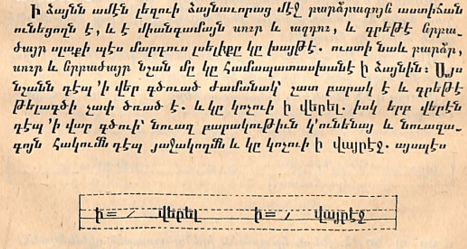
Vowels in this system are reasonable, with most of them being mere strokes or loops.
Especially compared to consonants.
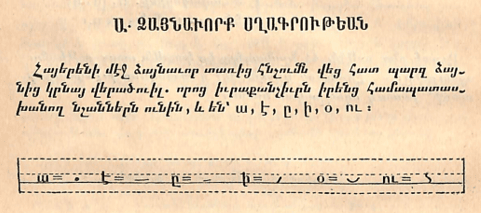
I attribute this ease to a ruthless culling they did to the vowel set. First, they came for semi-vowels, like “յ” (y/j,) “հ” (h,) and “ւ” (u/w.) Then, they came for diphthongs, like “աւ” (aw,) “եւ” (ew,) and “իւ” (iw,) replacing “ւ” with “վ” (v.) Finally, they cut out “duplicate” vowels, like “ը” and “ե” replaced with “է.”
There are also alternative strokes for “ա” (a) and “ի” (i,) quite similar in character to
alternative vowels in GESS.
Syllables: Useless and Outdated #
Syllables / diphthongs were probably informed by the writing / printing these Mekhitarists consumed and did.
Because why else would they include it?
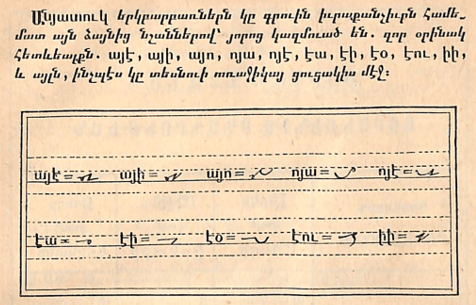
But, as much (= not much) as I have heard and read modern Armenian… These are useless. So learning these will only hinder one in recording modern (Eastern) Armenian speech. Dunno.
Summary: Not a Useful System #
I don’t see how this system might be useful compared to systems like Gregg or GESS with additional accents. It’s mostly a historic curiosity by this point. But it was fun and I don’t regret the $20 I paid for a digital copy of the book.